The Lone Spark: Why Your Breakthrough Ideas Need Silence Before They Need a Room
Here's something nobody tells you when you're building a creative team: the best thing that team can do for your project might be to temporarily stop talking to each other.
That sounds harsh. Maybe even counterproductive. But spend enough time making things — films, campaigns, visual narratives, anything that requires more than one human brain — and you start to notice a pattern. The ideas that actually move a project forward rarely come out of a scheduled meeting. They show up in the car. In the shower. At 11pm when you're not trying to think about the project at all.
There's a reason for that, and once you understand it, you can start designing your creative process around it instead of fighting against it.
The Myth of the Productive Brainstorm
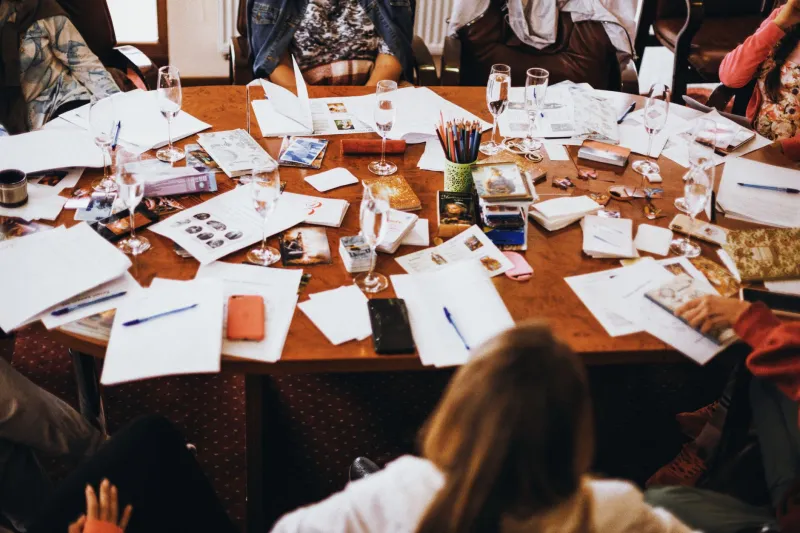
American work culture loves a brainstorm. Whiteboards, sticky notes, someone's laptop connected to a TV that took fifteen minutes to get working — we've all been there. The assumption is that gathering smart people in the same room and pointing them at a problem will generate the best possible solutions.
Sometimes it does. But a lot of the time, what a group brainstorm actually generates is consensus disguised as creativity. People build on each other's ideas, which feels generative, but what's really happening is a kind of gravitational pull toward the middle. The wild idea, the genuinely strange angle, the thing that nobody's thought of before — those get smoothed out in real time because social dynamics are always operating underneath the creative ones.
You don't want to look foolish. You don't want to slow things down. So you self-edit before the idea even leaves your mouth.
Solitude removes that filter.
What Happens When You Work Alone (Even Briefly)
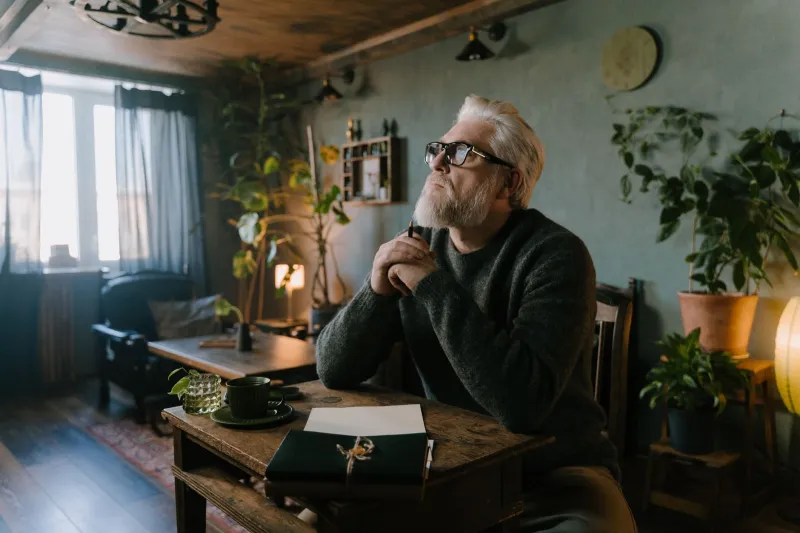
When you step away from the group — even just for an afternoon — something shifts. The pressure to perform creativity in front of other people disappears. You're not managing anyone's reaction. You're not building consensus. You're just thinking.
And thinking alone, it turns out, is a completely different cognitive activity than thinking in a group. Research in psychology has long pointed to a phenomenon sometimes called "incubation" — the idea that your brain keeps working on a problem after you've consciously stepped away from it. That's why the shower breakthrough is a real thing. You stopped forcing it, and your mind filled in the gap.
For filmmakers and visual storytellers specifically, this matters enormously. The decisions that define a project's identity — the tonal choice, the structural instinct, the visual metaphor that ties everything together — those are rarely the product of committee. They come from one person sitting with the material long enough to hear what it's actually trying to say.
The Rhythm Nobody Talks About
Here's the reframe: collaboration isn't a constant state. It's a phase.
The most effective creative processes tend to follow a rhythm that looks something like this — individuals generate, then the group refines. You bring something to the table, not a blank page. You've already done the hard, quiet work of finding the idea. Now the team's job is to stress-test it, sharpen it, and figure out how to execute it together.
When you skip the first part and go straight to the group, you're asking people to build a house without a foundation. The conversation becomes circular because there's nothing solid to push against yet.
This is especially true in filmmaking, where a director's singular vision is often what gives a project its coherence. That doesn't mean it's a dictatorship — the best directors are incredible collaborators. But they come to those collaborations having already done the interior work. They've lived with the story. They know what they're reaching for, even if they can't fully articulate it yet. That clarity is what makes the collaboration productive instead of just loud.
Building Solitude Into Your Process
So what does this actually look like in practice? A few things that tend to work:
Protect the early stage. Before a project goes into any kind of group discussion, give the lead creative — whether that's you or someone on your team — real time alone with the material. Not a deadline. Not a presentation date. Just space. This is where the actual idea forms.
Separate generation from evaluation. When you do bring the group in, be explicit about what mode you're in. Are you generating, or are you evaluating? Those are different conversations and they require different energy. Mixing them is how you kill a fragile idea before it has any muscle.
Send people away on purpose. Mid-project, when things start to feel stuck or muddy, consider the counterintuitive move: break the group up. Give everyone a day or two to sit with the problem individually and come back with their own take. You'll often find that the answers were already there — they just needed the noise to stop.
Respect the decompression period. After a long collaborative session, your brain needs time to process. Don't schedule back-to-back creative meetings and expect the second one to be as sharp as the first. Build in gaps. The ideas that surface in those gaps are usually the ones worth keeping.
Collaboration Is Still the Point
None of this is an argument for going it alone. The whole point of building a creative team is that other people see things you can't, catch what you miss, and push the work somewhere you wouldn't have taken it by yourself. That's real and it's valuable.
But collaboration works best when it has something to collaborate around. An idea that's been developed enough to have a point of view. A vision that's clear enough to be challenged. You can't refine nothing.
The paradox is that the more seriously you take your collaborative process, the more seriously you have to take the solo work that feeds it. The two aren't in competition. They're in sequence.
Get the sequence right, and you'll find that your team meetings get sharper, your decisions get faster, and the work starts to feel like it has a spine. Because it does — you built it in the quiet, before anyone else was in the room.